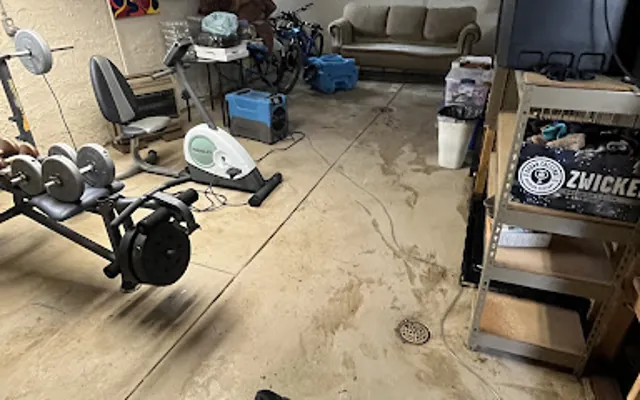
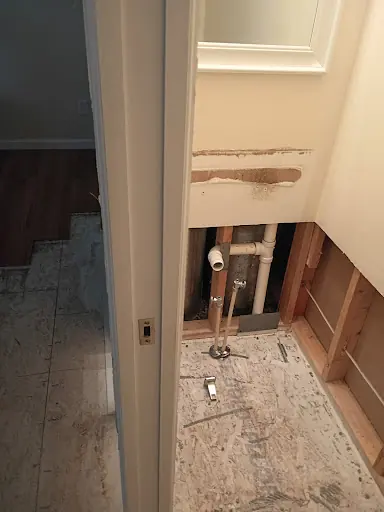
A pinhole leak under a slab can wick up through flooring for days before it shows. Charleston crews locate it, extract the moisture, and dry the affected rooms, responding 24/7 and reaching most Lowcountry addresses in about an hour, working to IICRC standards.

The crew uses moisture meters, thermal imaging, and acoustic methods to pinpoint the leak under the slab so access is precise, not guesswork.
Water that has wicked up into flooring and the slab is extracted, and affected flooring is lifted where it cannot be dried in place.
Air movers and specialized mat systems dry the slab, subfloor, and lower walls to a moisture-verified target.
The plumbing repair to stop the leak is coordinated, and flooring and baseboards are restored once the slab reads dry.

While help is on the way, these first steps, done only where it is safe, limit the damage and protect the insurance claim.
Shut the supply off at the source, or close the home's main valve if the source is not obvious. Stopping the flow limits the damage more than anything else.
Switch off electricity to the affected area, but only if the breaker can be reached without standing in or touching the water.
Get a crew dispatched right away. The sooner extraction and drying begin, the more flooring, drywall, and belongings can be saved.
Take photos and a short video of the water and the affected rooms before anything is moved, so the insurance claim starts strong.
Slab leak water damage cleanup in Charleston typically runs about $1,500 to $6,000, depending on how long the leak went unnoticed, how far the moisture spread under the flooring, and how much slab and flooring has to be dried or replaced. The plumbing repair itself is separate. Sudden slab leaks are often a covered homeowner claim, and the loss is documented for the adjuster.
Crews reach Charleston and the Lowcountry fast, from the peninsula and Wagener Terrace to West Ashley, James Island, and Johns Island, plus nearby Mount Pleasant, North Charleston, and the barrier islands. See the full list on the areas served across Charleston page.
See all areas servedEvery loss is photographed, measured, and logged from the first visit, so the paperwork holds up with your insurance carrier.
Technicians follow recognized IICRC drying standards and prove the work with daily moisture readings, not guesswork.
Emergency dispatch any hour of the day or night, with a real crew on the way, not a callback in the morning.
A real crew dispatched any hour, not a callback in the morning.
Trained technicians following recognized IICRC drying standards.
Truck-mounted, portable, and submersible for any size loss.
The loss is documented and billed to the carrier directly.
Common signs are a warm or damp spot on the floor, a water bill that jumped for no reason, the sound of running water with all fixtures off, or flooring and baseboards that swell without a visible source. A crew can confirm it by locating moisture under the slab.
No. The leak is pinpointed first with moisture, thermal, and acoustic tools so access is targeted to the leak location. That keeps the opening as small as possible and avoids tearing up flooring that does not need to come out.
The resulting water damage from a sudden slab leak is often covered by a homeowner policy, though the plumbing repair itself may not be. Coverage varies, so the damage is documented with photos and moisture readings to support the claim.
Yes. Water wicking up from a slab leak stays trapped under flooring and against baseboards in the humid climate, which can grow mold if it is not dried out. Drying the slab and finishes to a verified level is what prevents that.
Charleston crews are on call 24 hours a day, local and fast, and can be on the way within the hour.
Call (843) 701-9240